Multimodal AI Models Tackle Healthcare's Data Silos
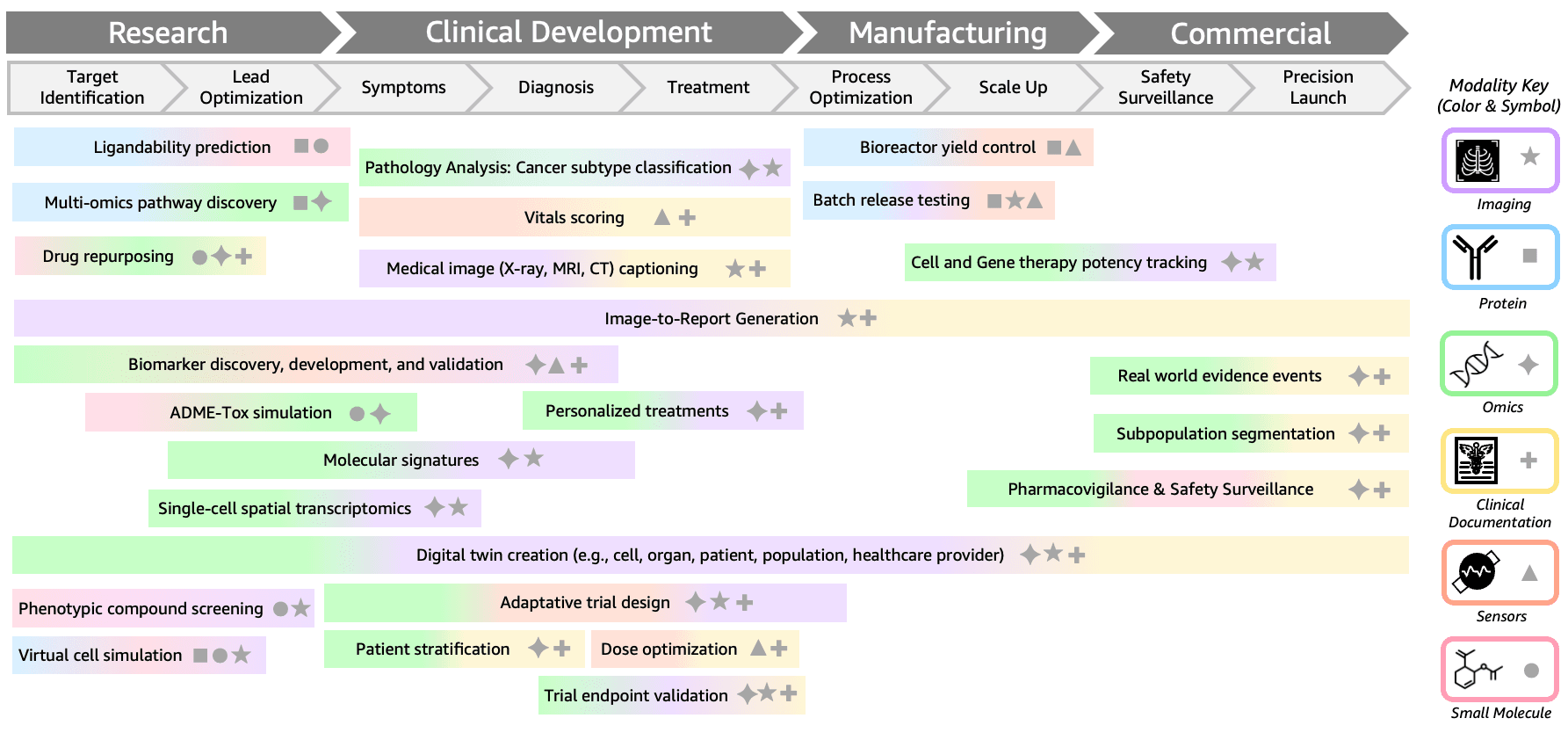
AWS is positioning itself as a unified platform for deploying multimodal biological foundation models that integrate fragmented healthcare data streams, omics, medical imaging, and clinical records to improve drug discovery and patient care decisions. The article outlines how these models differ from single-modality predecessors, highlights examples like Latent Labs' protein design tools and Arc Institute's Evo 2, and frames AWS infrastructure as enabling organizations to build and scale these systems. The core value proposition is that decision makers can now access cross-modal insights previously hidden in siloed data sources.
TL;DR
- →Multimodal biological foundation models train across multiple data types (text, images, omics, clinical records) simultaneously, unlike single-modality models that focus on one domain like protein structure prediction.
- →Current BioFM usage breaks down roughly as clinical documentation (35%), omics analysis (30%), protein and molecule design (20%), and medical imaging (15%), per Delile et al. 2025.
- →Notable examples include Latent Labs' Latent-X1/X2 for antibody and binder generation, Arc Institute's Evo 2 for DNA/RNA/protein prediction, Insilco Medicine's Nach01 for drug discovery, and Bioptimus' M-Optimus for histology and clinical integration.
- →AWS is marketing itself as infrastructure and tooling for organizations to build, train, and deploy these multimodal models at scale across the drug development lifecycle.
Why it matters
Multimodal foundation models represent a shift from isolated analytical pipelines to integrated systems that can reason across biological, chemical, and clinical data simultaneously. This mirrors the broader foundation model trend in AI but applied to a domain where data fragmentation has historically limited insight extraction. The ability to cross-reference protein structures, molecular interactions, patient records, and imaging in a single model could accelerate both drug discovery and personalized medicine workflows.
Business relevance
For biotech, pharma, and healthtech operators, multimodal BioFMs reduce time-to-insight in drug development and enable more confident clinical decision-making by surfacing relationships across data silos. AWS's positioning as a platform provider creates a market opportunity for infrastructure, managed services, and partner integrations, while also lowering barriers for smaller organizations to access these capabilities without building from scratch.
Key implications
- →Multimodal models may accelerate drug discovery cycles by enabling simultaneous analysis of molecular design, target interaction, and clinical trial outcomes rather than sequential, fragmented workflows.
- →Organizations without in-house AI expertise can now leverage pre-trained BioFMs and AWS infrastructure, potentially democratizing access to advanced computational biology tools beyond large pharma.
- →Data integration and standardization across omics, imaging, and EHR systems becomes a competitive advantage, as model performance depends on quality and completeness of cross-modal training data.
- →Regulatory and validation frameworks for multimodal models in clinical settings remain unclear, creating uncertainty around deployment timelines for patient-facing applications.
What to watch
Monitor how quickly organizations move multimodal BioFMs from research to production in clinical workflows, particularly in personalized medicine and rare disease diagnosis. Watch for regulatory guidance on validation and interpretability of multimodal models in drug development and patient care. Track whether AWS's platform approach gains adoption relative to competitors offering similar capabilities, and whether data standardization efforts across healthcare systems accelerate to support these models.
vff Briefing
Weekly signal. No noise. Built for founders, operators, and AI-curious professionals.
No spam. Unsubscribe any time.