Google Splits TPUs Into Training and Inference Chips
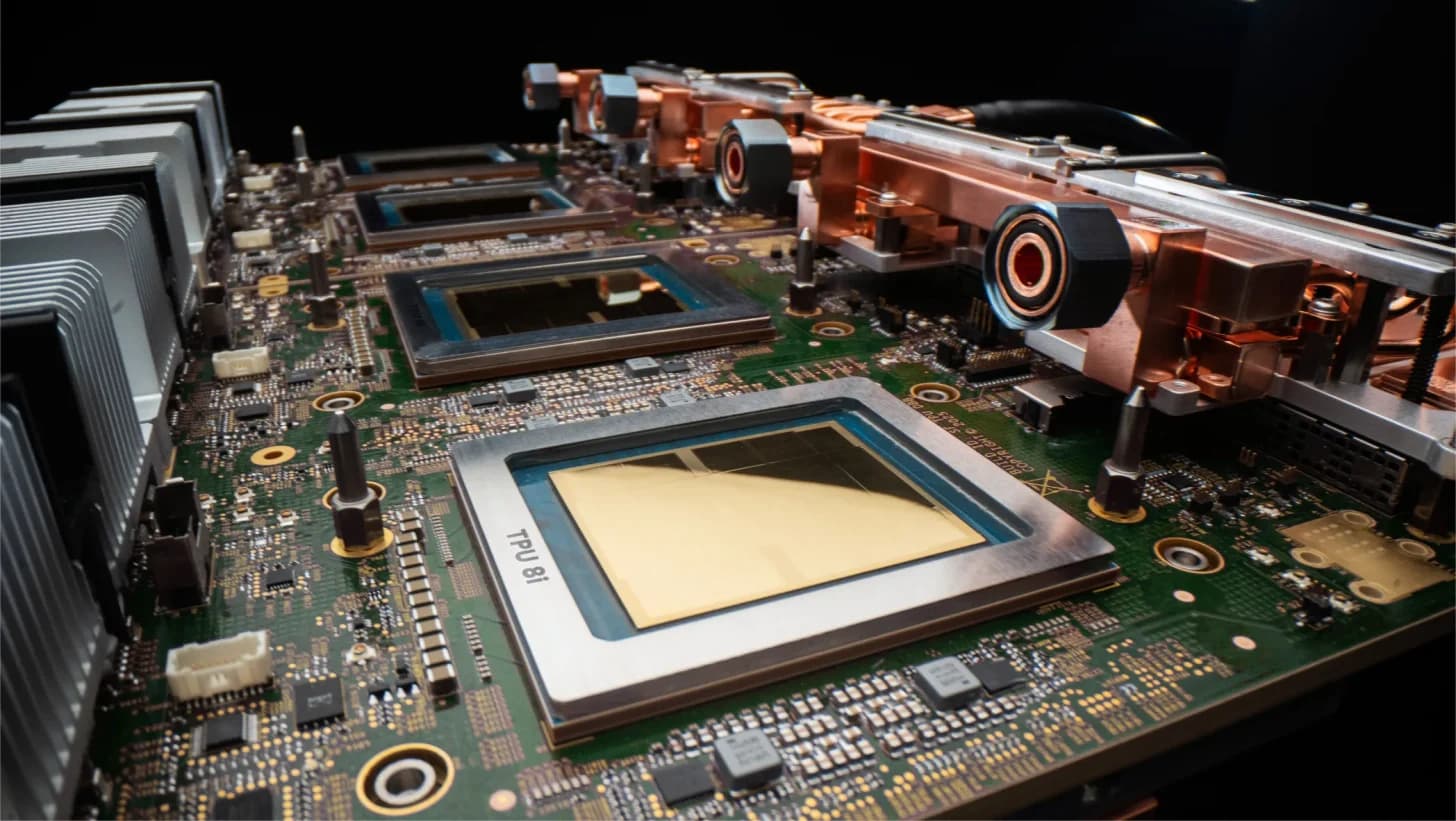
Google is splitting its eighth-generation tensor processing units into separate chips optimized for AI training and inference, a shift the company says reflects the rise of AI agents and their distinct computational needs. The training chip delivers 2.8 times the performance of its predecessor at the same price, while the inference processor (TPU 8i) achieves 80% better performance and includes triple the SRAM of the prior generation. Both chips will launch later this year as Google continues its effort to compete with Nvidia in custom AI silicon, though the company is not directly benchmarking against Nvidia's offerings.
TL;DR
- →Google separates training and inference into distinct TPU chips for the first time, reflecting specialized demands of AI agents
- →Training TPU achieves 2.8x performance improvement over prior generation at same cost; inference chip (TPU 8i) gains 80% performance with 384MB SRAM (triple prior generation)
- →Adoption is accelerating: Citadel Securities, all 17 U.S. Energy Department national labs, and Anthropic are deploying Google TPUs at scale
- →Tech giants across the industry are pursuing custom AI silicon; Google remains a distant second to Nvidia despite improvements and growing customer base
Why it matters
The shift to specialized training and inference chips reflects a maturing AI hardware market where workload-specific optimization is becoming table stakes. Google's move signals that the era of general-purpose AI processors is giving way to architectures tailored for distinct phases of the AI lifecycle, a pattern now being followed by Microsoft, Meta, and others. This fragmentation could reshape how companies architect their AI infrastructure and where they source silicon.
Business relevance
For operators and founders, this means more options for cost-optimized AI infrastructure, but also increased complexity in chip selection and potential lock-in to specific cloud providers. Companies like Anthropic committing gigawatts of Google TPU capacity suggests the chips are becoming viable alternatives to Nvidia for certain workloads, which could shift procurement decisions and cloud strategy. The emphasis on low-latency inference with high throughput directly addresses the operational constraints of deploying AI agents at scale.
Key implications
- →Specialization is becoming the competitive lever in AI hardware, not raw performance alone, as companies optimize for specific workloads rather than general compute
- →Google's growing adoption base (Citadel, Energy Department labs, Anthropic) indicates TPUs are moving beyond internal use into production systems, though Nvidia remains dominant
- →The focus on SRAM and low-latency inference suggests the industry is optimizing for concurrent multi-agent deployments, a shift from single-model inference patterns
What to watch
Monitor adoption velocity among enterprise customers and whether Anthropic's commitment to Google TPUs signals a broader shift away from Nvidia dependency. Track whether other cloud providers (AWS, Azure) accelerate their own custom silicon roadmaps in response. Watch for performance benchmarks that directly compare Google's new chips to Nvidia's Groq 3 LPU, which Google notably avoided in this announcement.
vff Briefing
Weekly signal. No noise. Built for founders, operators, and AI-curious professionals.
No spam. Unsubscribe any time.